 WithCryptoWatches
WithCryptoWatches
WithCryptoWatches
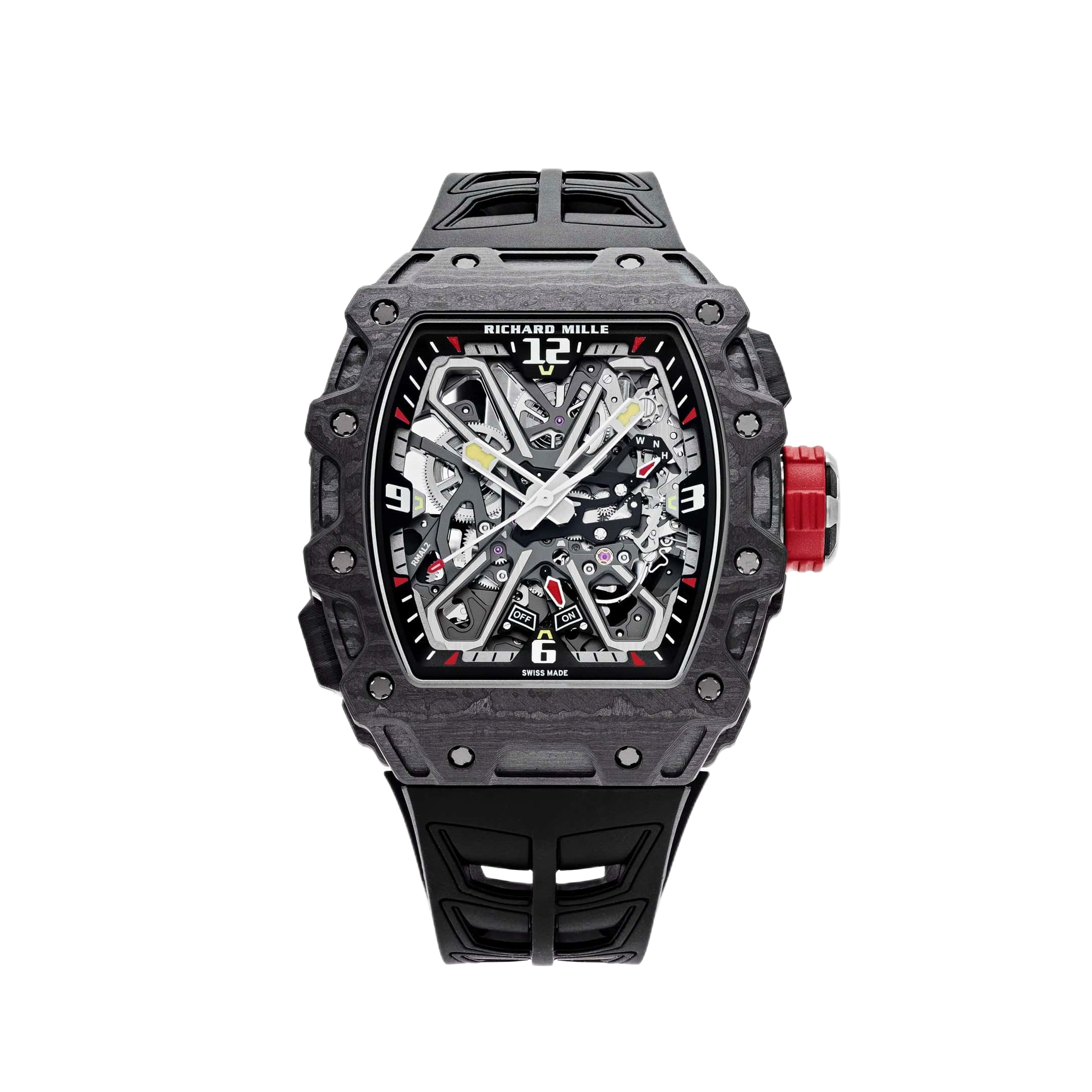
Exploring the history, innovation, and extreme performance of the 'Racing Machine on the Wrist.'
View Available CollectionFor centuries, Swiss horology was defined by the so-called “Big Three”—Patek Philippe, Audemars Piguet, and Vacheron Constantin. Their philosophy centered on hand-finishing, precious metals, and traditional complications. In 2001, Richard Mille shattered this paradigm.
The objective was not simply to create another luxury watch, but to engineer a high-performance wearable structure. Every Richard Mille timepiece is built on three foundational pillars:
While conventional luxury watches rely on steel or gold, a Richard Mille is an experiment in advanced material science. Understanding its value requires understanding the cost and complexity of working with these elements.
Carbon TPT® is composed of ultra-thin layers of parallel carbon filaments—each no thicker than 30 microns—saturated with resin and woven with a 45° rotation between layers.
The Result: A unique Damascene-style surface pattern—no two watches are identical.
The Benefit: Exceptional resistance to micro-cracks and an extraordinary strength-to-weight ratio.
Produced using the same process as Carbon TPT®, Quartz TPT® utilizes silica fibers capable of withstanding extreme heat and remaining transparent to electromagnetic waves. Its vibrant colors have become iconic within the RM collection.
Used primarily on Grade 5 titanium baseplates, Titalyt® is an electro-plasma oxidation process that creates a biocompatible, ceramic-like surface, dramatically increasing rigidity and wear resistance.
The phrase “Racing Machine on the Wrist” is literal. Richard Mille movements are engineered to survive conditions that would destroy traditional calibers.
Shock Resistance: Models such as the RM 35 and RM 27-04 are tested to withstand shocks up to 12,000 Gs.
Suspended Movements: Some calibers are mounted using braided steel cables just 0.27mm thick, allowing the movement to float and absorb extreme vibrations.
Variable Geometry Rotors: Found in models like the RM 11-03, the winding efficiency can be customized to match the wearer’s activity level.
The RM 11 series is the backbone of the brand. The RM 11-03 represents the pinnacle of the lifestyle flyback chronograph.
Flyback Chronograph: Enables instant reset without stopping the timer.
Annual Calendar: Automatically adjusts for 30- and 31-day months.
Designed for elite athletes, the RM 67-02 weighs so little it virtually disappears on the wrist—even during world-record performances.
Comfort Strap: Seamless, elastic construction that conforms perfectly to wrist anatomy.
Ultra-Thin Dial: Machined from 0.40mm titanium and hand-painted in national colors.
Richard Mille’s tonneau-shaped case consists of a front bezel, caseband, and back bezel—each machined to extreme tolerances.
Curved on both sides for ergonomic perfection, the case uses dual Nitril O-ring seals and 20 Grade 5 titanium spline screws to maintain water resistance under immense structural tension.
Richard Mille timepieces retain value due to a rare combination of scarcity, innovation, and cultural dominance.
Acquiring a Richard Mille is a milestone. At WithCryptoWatches, we ensure the experience reflects the engineering.
The RM 11 is to Richard Mille what the 911 is to Porsche—an enduring silhouette that evolves relentlessly while preserving its core DNA. To truly understand the brand’s philosophy of “Engineering Luxury”, one must examine how this singular lineage has progressed over time.
Developed in collaboration with Formula 1 driver Felipe Massa, the original RM 011 was engineered to withstand the relentless vibrations and G-forces of a Grand Prix cockpit.
It introduced the RMAC1 movement, featuring an oversized date at 12 o’clock and a month indicator—marking the first successful integration of an annual calendar into a fully skeletonized flyback chronograph designed for extreme sports.
Named after legendary football manager Roberto Mancini, this variation adapted the flyback chronograph for the soccer pitch.
The dial was reprogrammed to track two 45-minute halves plus extra time, demonstrating that Richard Mille movements could be purpose-built for specific human pursuits—extending the brand’s philosophy beyond motorsport and into elite athletics.
Introduced in 2014, the RM 11-02 expanded the collection’s functionality with a UTC dual time zone complication.
Easily identified by the additional pusher at the 9 o’clock position, this feature allows the second time zone hand to be adjusted independently—an essential tool for the modern, globally mobile collector.
Released in 2016, the RM 11-03 marked a decisive shift toward a more aggressive, three-dimensional architectural language.
The case became sharper and more angular, the crown evolved into an ergonomic, tire-tread-inspired design, and the movement was completely re-engineered. The new RMAC3 calibre, constructed entirely from Grade 5 titanium, delivers enhanced shock resistance and an extended 55-hour power reserve.
Beneath the Carbon TPT® cases and Grade 5 titanium structures exists a realm of micro-mechanical engineering that fewer than one percent of watch brands on Earth can execute. This is where Richard Mille’s true advantage is forged.
Among Richard Mille’s most significant innovations is the variable-geometry rotor. While traditional automatic movements wind at a fixed rate, Richard Mille calibers allow a watchmaker to fine-tune rotor inertia based on the wearer’s lifestyle.
A defining visual signature of any Richard Mille is its bezel hardware. These are not conventional flat-head screws, but precision-engineered Grade 5 titanium spline screws.
Spline screws enable exact torque calibration during assembly, ensuring uniform pressure across the Nitril O-ring seals. This allows the case to maintain water resistance even when subjected to extreme thermal expansion in desert heat or tropical humidity.
Select models incorporate advanced technical ceramics such as TZP (Tetragonal Zirconia Polycrystal) and ATZ (Alumina-Toughened Zirconia).
These biocompatible materials approach diamond-level hardness, making them virtually scratch-proof. Favored for bezels on models like the RM 11-03, they preserve their matte or polished finish for decades, regardless of daily wear.
In 2026, Richard Mille continues to defy traditional luxury-watch market cycles. While precious-metal prices fluctuate, the brand’s obsession with “Technicity” has created a self-sustaining value ecosystem.
Whether you seek the ultra-flat athletic elegance of the RM 67-02 or the mechanical complexity of the RM 11-03 McLaren, our curated collection represents the apex of high-performance horology.
These are not merely watches—they are the culmination of thousands of hours of research and development, engineered for individuals who demand the same uncompromising performance from their wrist as they do from their lives.
Purchasing a Richard Mille on the secondary market is an exercise in precision and due diligence. Use these five pillars to ensure authenticity, protect your capital, and secure a legitimate masterpiece of high-performance horology.
Every authentic Richard Mille is issued with a unique warranty folder—far more sophisticated than the plastic cards used by most luxury brands.
Counterfeiters frequently fail when attempting to replicate the precision of Richard Mille’s engraving techniques.
Extreme lightness is a defining Richard Mille signature—and one of the hardest qualities for counterfeiters to replicate.
Richard Mille’s fully skeletonized movements leave nothing to hide—making this the most revealing inspection point.
A Richard Mille is a high-revving mechanical system—closer to an F1 engine than a traditional dress watch.
The RM 11 series stands as the undisputed flagship of Richard Mille. For collectors and investors alike, understanding production timelines, material experimentation, and mechanical evolution is essential to identifying long-term value.
Within each RM 11 generation, Richard Mille released limited “editions” that have since achieved grail status—often outperforming standard titanium models on the secondary market.
Prior to its discontinuation in favor of the RM 11-03, the RM 011 became a testbed for some of the brand’s most daring material innovations.
With the RM 11-03, Richard Mille elevated collaborative engineering to an entirely new level, merging motorsport, design, and advanced materials.
Introduced in 2020 and limited to only 140 pieces, the RM 11-05 pushed material science even further with the debut of Grey Cermet.
This metal matrix composite combines the lightness of titanium with near-diamond hardness (2,360 Vickers). Its use in ballistic armor and high-performance braking systems underscores the extreme engineering philosophy behind the model.
Collectors often question why the RM 11-03 and RM 11-05 command significant premiums over the original RM 011. The answer lies in the evolution of the movement architecture.
A Richard Mille is not a conventional luxury watch—it is a high-performance mechanical system. Proper maintenance ensures not only aesthetic preservation, but long-term mechanical integrity and value retention.
Each material used in the Richard Mille catalog reacts differently to environmental exposure. Incorrect cleaning agents can degrade seals or permanently alter surface finishes.
These advanced composite materials are exceptionally strong yet capable of trapping microscopic debris within their layered grain structure.
Recommended Method: Use a soft-bristled toothbrush with a pH-neutral, mild soap. Rinse using lukewarm water—never hot.
Critical Warning: Avoid abrasive cloths. Over time, they can subtly polish the matte surface, erasing the material’s signature texture.
Grade 5 titanium may develop fingerprint oil buildup, causing localized darkening or a dull appearance.
Recommended Method: Gently wipe with a microfiber cloth slightly dampened with distilled water. The alloy’s corrosion resistance makes routine care straightforward.
These technical ceramics are virtually scratch-proof, though brittle under extreme impact.
Recommended Method: Clean using a dry, high-quality microfiber cloth. Ceramic does not oxidize and will retain its boutique-level finish indefinitely with minimal intervention.
Richard Mille’s tripartite case relies on precision-fitted Nitril O-ring seals to protect the movement from moisture ingress.
Straps are integral to the Richard Mille wearing experience, particularly the ultra-light Velcro® systems used on performance models such as the RM 67-02.
While Richard Mille movements utilize non-ferrous materials, the hairspring can still be affected by strong magnetic fields.
Richard Mille movements are engineered to be worn, thanks to their variable-geometry rotors.
The Verdict: Continuous use of a watch winder can introduce unnecessary wear on the ceramic ball bearings within the rotor assembly.
Our Recommendation: Allow the watch to stop when not in use. When ready to wear, manually wind approximately 20–30 turns to distribute lubricants evenly without inducing mechanical fatigue.
A Richard Mille is not merely a timepiece—it is a six-figure work of micro-engineering. Treating it with the same discipline as a high-performance engine ensures it will remain mechanically sound, aesthetically pristine, and investment-grade for generations to come.